( 2003 ). Economics: Principles in Action. Upper Saddle River, New Jersey 07458: Pearson Prentice Hall. p. 513. ISBN 0-13-063085-3. CS1 maint: place (link) Kapoor, Jack R.; Dlabay, Les R.; Hughes, Robert J. (2007 ). Focus on Personal Financing. Mcgraw-Hill/Irwin Series in Finance, Insurance and Realty (second ed.). Mcgraw-Hill. ISBN 0-07-353063-8. Giovetti, Al (2008 ).
As a consumer nowadays it's easy to seem like you invest half your cash on charges you do not see coming or, many of the time, even comprehend. Order a $5 beer and the expense requests $6. 50 after taxes and tip. Flying overseas? That discount rate ticket you got so ecstatic over will cost an extra $200 in "departure charges." Heaven assist you if you've purchased show tickets.
A lot of particularly, this is a common feature on credit card costs and other lending statements. Here's what it indicates and what, exactly, you're paying for. A financing charge is the amount of cash charged by a lender in exchange for offering you credit. Put another method, it's the expense of borrowing cash.
Of these, the most common finance charge is interest, as practically any expert loan will charge a rates of interest. It is very important to comprehend that while the majority of coverage of this topic goes over finance charges in the context of charge card financial obligation, as will this piece for demonstrative functions, they apply to all forms of financing.
5 Easy Facts About What Is Internal Rate Of Return In Finance Shown
There is no single approach for examining financing charges. Lenders can compute them at any point based on the information of the loan. However, when your lending institution evaluates a finance charge is actually rather considerable. Particularly for percent-based charges, it can make a big distinction in just how much you pay.
A charge card billing cycle is one month, although officially the charge card business may note the billing cycle as anywhere from 24 to 33 days depending upon how it notes weekends and vacations. At the end of each billing cycle your credit card business sends you a bill for that month's spending.
A charge card business uses interest and finance charges at the end of each billing cycle based upon whether or not the previous costs was paid in full. If you paid your whole balance on the last expense then it doesn't use any interest to the new one. If you have an overdue balance at the end of a billing cycle it uses interest usually to both the previous balance and the most recent purchases.
May 4: at 11:59 p. m. the previous billing cycle ends. May 5: at midnight the new billing cycle begins. All purchases that you make on the http://cashynyb327.image-perth.org/everything-about-when-studying-finance-or-economic-the-cost-of-a-decision-is-also-known-as-a-n credit card will now go on the next month's expense. May 5: the credit card company calculates and sends out your bill for the previous billing cycle.

Rumored Buzz on What Is A Note In Finance
May 26: the $1,000 bill for the previous billing cycle is due, as 21 days is the minimum payment period by law. You pay $500 of it. June 4: at 11:59 p. m. this billing cycle ends. You have actually made $1,500 in extra purchases over the previous month. June 5 at midnight the brand-new billing cycle starts.
You have an existing balance of $500. The credit card company includes that to your $1,500 in new spending, then uses interest to the entire balance. It sends out a last bill based upon your interest rate which will be due June 26. In the alternative: You pay the entire costs on May 26.
You have an existing balance of $0. As an outcome it charges no interest and sends a last costs just for your most current costs of $1,500. There is no set formula for how lenders can assess a finance charge. Financing charges can be swelling sum or based on a portion of the loan.
They can be part of a monthly bill or examined based on specific situations (such as late charges). Comprehending how financing charges are calculated is crucial. To comprehend that, here is a summary of how a normal charge card business charges interest. As gone over above, credit cards only charge interest when you bring an existing balance from month to month.
All About What Does A Finance Major Do
This is called the "grace duration," and it applies to making purchases with any basic charge card. Some specific types of spending do not have this grace period. Most especially, if you secure a cash advance, your credit card will normally start to charge interest right away. If you pay less than the complete quantity due, you lose the grace duration.
Second, you will owe interest on all brand-new purchases going forward until the whole costs is paid. This implies that if you owe $500 at the beginning of the billing cycle and make $1,500 in new purchases, you will owe interest on the full $2,000 at the end of that billing cycle.
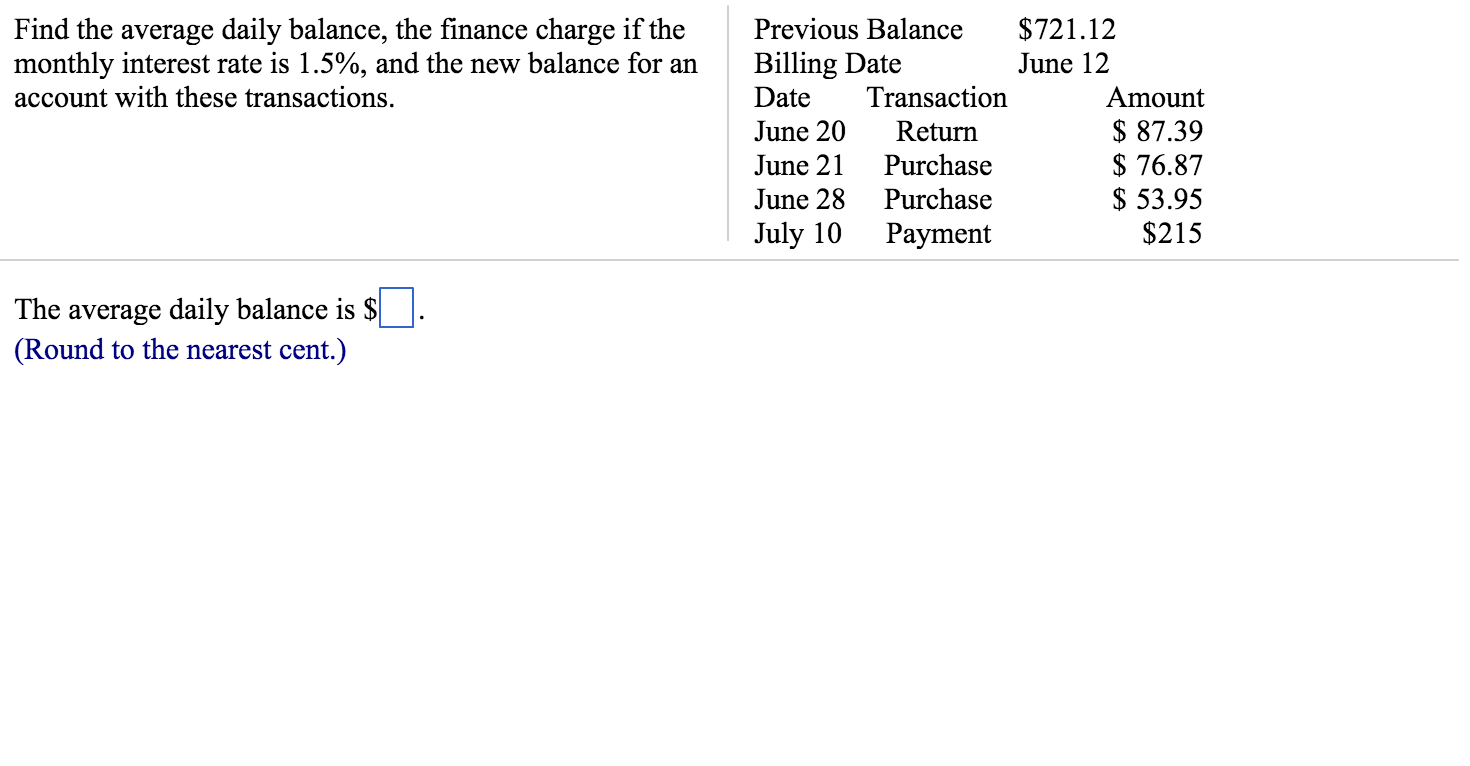
This suggests that the company charges interest on a day-to-day basis for each purchase made. To calculate this the company: First divides your rate of interest (the APR) by 365 to identify your day-to-day interest rate. For example, if you have a 15% APR your day-to-day rate of interest would be 15/365 = 0.
Then the business multiplies your daily interest rate by the number of days in the billing cycle. For example, in a 30-day month at 15% APR, that month's statement would have a rates of interest of 1. 23%. Finally the business multiplies your declaration rates of interest by the outstanding balance.
The Single Strategy To Use For What Is A Future In Finance
23% declaration rate of interest, you would owe $24. 60 in interest. Some business also use what is called the Daily Balance technique. Under this technique, the company calculates your daily interest rate and after that applies it to each day's existing balance as the month goes on. Then the company adds all of those day-to-day interest estimations together to get your total finance charge for the month.
There are some financing charges you can not prevent. Any built-in service charge, for example, are inescapable. Some, nevertheless, you can get around. The most typical ways to avoid finance charges are: - Making your minimum payments can prevent late costs, which accumulate rapidly and can typically come to even more than the minimum payments themselves.
- The only method to avoid charge card interest is by making your full payment when each bill is due. If you do this, you will not get any financing charges. Otherwise, you will carry a balance and the credit card will charge you for it. Financial titans Jim Cramer and Robert Powell are bringing their market savvy and investing strategies to you.
Updated August 28, 2020A financing charge is the cost credited a debtor for using credit extended by the loan provider - how to start a finance company. Broadly defined, financing charges can consist of interest, late charges, deal charges, and upkeep costs and be assessed as an easy, flat cost or based on a portion of the loan, or some combination of both.